If you tow a boat around Osage Beach, you already know the drive. You come off the ramp with a loaded trailer behind you, the pavement tilts up, and you feel the whole rig lean on the drivetrain all the way back to MO-54. It’s a short pull. It’s also the hardest thing most tow vehicles at the Lake of the Ozarks ever do.
Here’s what a lot of drivers miss: that climb doesn’t stress one part of your truck. It heats three separate systems at once, and it heats them in a way that makes each one worse for the others. Your transmission is working hardest. Your engine is making its most heat. And your brakes, which haven’t done a thing yet, are about to be asked for everything on the way back down. Here’s what happens to each system, what the warning signs feel like, and what to do about it.
Why the Hills Around the Lake Are Harder on Your Truck Than the Highway
Osage Beach sits at roughly 656 feet of elevation, with Lake of the Ozarks State Park just above it near 663 feet, tucked into the hilly Ozarks terrain of Camden and Miller counties. What those numbers don’t show is the shape of the ground between the water and the road, which is exactly the profile that punishes a tow vehicle: short, steep, repeated grades instead of one long steady climb.
The state park alone has three paved public ramps, a four-lane ramp at Grand Glaize Beach, a four-lane ramp at Pa He Tsi, and a two-lane ramp at Public Beach #1. You back down to the water, load up, then drag a few thousand pounds of boat and trailer back up to the highway, usually in July, usually with the air conditioning on high. The pulls in and out of Lake Ozark, Camdenton, Sunrise Beach, and Laurie are no gentler.
That combination is what makes towing here different from towing on flat ground. On a grade, under load, in summer heat, a vehicle that behaves perfectly on the highway can push its fluids past the temperatures they were designed to live at, and it can do it in minutes. State towing safety guidance says as much: tow vehicles need more frequent oil and filter changes, lubrication, and cooling system checks than the same vehicle unloaded. Your truck isn’t being fussy. It’s doing a harder job.
Start with the Transmission: Heat Is What Kills It
Your automatic transmission turns engine power into forward motion, and the part of that power it fails to convert turns into heat inside the fluid. Add a loaded trailer and a grade and there’s much more of it to shed.
Transmission fluid doesn’t fail all at once. It fails at known milestones, and they’re closer to normal than most drivers expect. Around 220 degrees, varnish starts forming on the friction surfaces and hard parts inside the transmission. Around 240 degrees, seals begin to harden and the important additives in the fluid start to cook off. Around 260 degrees, the clutch plates start to slip because the fluid has broken down to the point where it can’t do its job anymore. Push it far enough and a typical transmission will die within about 2,000 miles of running at 300-plus degrees.
A hard climb with a trailer on a hot day is exactly the duty cycle that walks fluid up through those numbers. The damage adds up quietly, right up until it doesn’t.
This is where tow/haul mode earns its keep. If your vehicle has one, it changes shift points so the transmission stops hunting for the tallest gear it can hold, which cuts down on the slipping and the heat that slipping produces. State towing guidance is direct about it: some tow vehicles have specifically calibrated transmission tow-modes, and you should use the tow-mode the manufacturer recommends. Pressing that button at the ramp is one of the few things a driver can do mid-drive that genuinely lowers fluid temperature.
What it feels like when the transmission is too hot: a truck that shifts cleanly when empty starts hunting between gears on the climb, or the engine revs without the vehicle gaining speed. That flare is the transmission slipping in fluid that’s already past its limit. So is delayed engagement when you drop it into gear at the ramp. Any of those is a reason to line up transmission service at a Lake of the Ozarks shop that knows towing, instead of hauling the boat on it for another weekend.
Cooling System Repair in Osage Beach MO Starts with Knowing Your Margin
The temperature gauge is best understood as a fuel gauge for the margin you have left, and that margin is smaller and more specific than you’d think.
A standard 50/50 mix of water and ethylene glycol coolant boils at about 223 degrees on its own. What buys you more headroom is pressure. Coolant’s boiling point climbs about three degrees for every 1 psi of system pressure, so a 15 psi radiator cap adds roughly 45 degrees, for a final boiling point near 268 degrees. That’s your entire cushion, and it depends on parts that wear out.
Here’s the part that catches people. If the cap no longer holds its rating, if the coolant level has dropped, or if the coolant itself is old and tired, you lose some of that 45-degree cushion before you ever see anything unusual on the gauge. Add a radiator core packed with bugs and lake grit, a fan that isn’t pulling the air it should, and an AC compressor running flat out, and the truck is fighting on three fronts.
What it feels like: gauge creep. Not a red zone, not a chime, just the needle sitting noticeably higher than where it always sits around town, especially on the pull up from the water. That’s the sign worth acting on, because it shows up while you still have options. If the needle is creeping, get it looked at before the next tow: cooling system repair in Osage Beach MO is a far simpler job when the answer is still a cap, a flush, or a fan rather than a head gasket.
Brakes Get It Twice: Hot on the Way Up, Asked for Everything on the Way Down
Brakes are the system drivers worry about least on the way up and need most on the way back down, and around here they carry an unusual share of the load.
Most states require a loaded trailer over a certain weight to have brakes of its own. Missouri doesn’t work that way. The RV Industry Association’s state-by-state summary of trailer brake requirements lists Missouri as having no requirements at all, citing Missouri statute 307.170, while a state like Montana requires brakes on all wheels above 3,000 pounds. That doesn’t mean trailer brakes are a bad idea here. It means the opposite. Trailer brakes and a working breakaway system are genuinely worth having, and a used trailer bought locally may well have neither, in which case your tow vehicle’s pads, rotors, and fluid absorb the entire stopping job on every descent.
Now add heat. Holding a loaded rig on a grade puts real energy into the pads and rotors, and then the descent asks those same already-warm brakes to convert the weight of truck, trailer, and boat into heat all over again. The failure point is often the fluid, and federal standards spell out why. Under 49 CFR 571.116, DOT 3 brake fluid must have a minimum dry boiling point of 205 degrees Celsius, which is 401 degrees Fahrenheit. But brake fluid absorbs moisture over time, and the same standard sets the minimum wet boiling point at only 140 degrees Celsius, or 284 degrees Fahrenheit. DOT 4 tells the same story: 446 degrees dry, 311 degrees wet.
That drop is the mechanism behind a symptom every tower has heard about and few understand. Moisture-laden fluid boils in a hot caliper, vapor forms in the line, and vapor compresses in a way that liquid doesn’t. Your pedal was firm at the top of the hill and it’s long and soft at the bottom. The pads didn’t wear out in three miles. The fluid boiled.
Two habits prevent most of this, and both come straight from published towing guidance. First, downshift to assist with braking on downgrades, and to add power when climbing hills. Second, on a long downgrade, apply the brakes at intervals to keep your speed in check, and never leave them on for extended periods or they may overheat. Riding the pedal all the way down is the surest way to cook a brake system with a trailer behind you. If your pedal has ever gone soft on a descent, that’s a reason to book towing brake service in Osage Beach now, not at the end of the season.
The Four Warning Signs Worth Taking Seriously
You don’t need gauges to catch these.
- Temperature gauge creep. The needle sits higher than its usual spot on a climb. Act on it this week; it’s telling you your coolant cushion has shrunk.
- Shift flare or hunting. Revs rise without matching speed, or the transmission can’t settle on a gear under load. Fluid is too hot or too far gone. Stop towing on it.
- A smell at the top of the hill. Sweet usually means coolant. Sharp, acrid, hot-metal usually means brakes. Knowing which one you smelled tells the shop where to look first.
- A soft or long brake pedal after a descent. This is the stop-now sign. Pull over safely, let things cool, and don’t tow again until the brake system has been inspected.
Your Pre-Tow Checklist Before You Hook Up
None of this takes long, and it’s the same short list every time. Think of it as the towing version of the road trip prep we recommend before any long haul.
- Check engine oil, coolant, and transmission fluid at the start of every trip and each time you fuel up. That’s the published recommendation, not an upsell.
- Set tire pressure to the placard, on the tow vehicle and the trailer. Underinflation reduces load-carrying capacity, can cause sway and control problems, and can cause tires to overheat into a blowout or other failure. Our guide to inspecting your tires walks through what to look for.
- Look at the trailer tires and the spare. Trailer tires often age out before they wear out, which is why knowing the age of your tires matters as much as looking at the tread.
- Confirm the cap and the fan. Both are small parts guarding an expensive engine.
- Press tow/haul before you pull away from the ramp, if your vehicle has it.
What a Shop Actually Checks After a Season of Towing
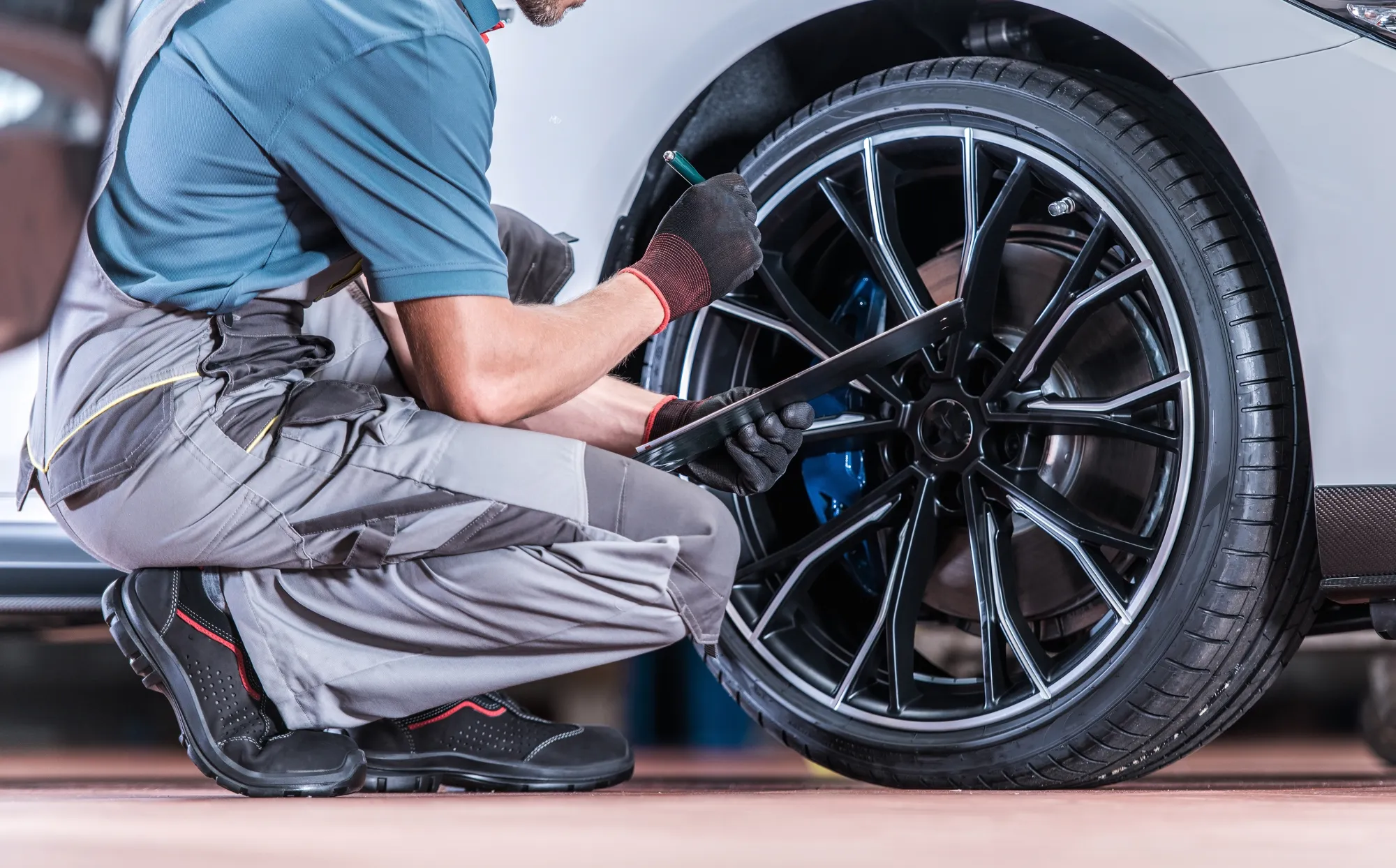
A towing-focused inspection isn’t the same as an oil change with a glance around. If you’ve been searching for a truck shop near you that understands trailers, this is the work that matters after a summer of ramp runs.
For the transmission, that means checking fluid level and condition, looking for the darkening and burnt smell that says the fluid has been past its milestones, and inspecting the cooler and lines. For the cooling system, it means a pressure test to see whether the system and the cap actually hold their rating, testing coolant condition rather than eyeballing its color, checking fan operation, and looking through the radiator core for the bugs and grit a season at the lake packs in. For the brakes, it means measuring pad and rotor thickness instead of guessing at them, testing the brake fluid for moisture content, and checking the trailer’s brakes, wiring, and breakaway setup if it has them. A road test under load ties it together.
What does that work cost? That depends entirely on your vehicle, what the inspection finds, and what parts are needed, so we don’t guess at it here. Contact the shop for a current quote on your specific vehicle and we’ll give you a straight answer before any work starts.
Trust the Experts at Sunset Tire and Service
Towing at the Lake isn’t hard on your truck because your truck is weak. It’s hard because a loaded trailer, a steep grade, and Missouri summer heat all show up on the same climb, and brakes, transmission, and cooling don’t give you much warning before they quit.
Sunset Tire and Service works on the trucks and SUVs that tow around Osage Beach, Lake Ozark, Camdenton, and the rest of the Lake of the Ozarks every week, so we know what the ramps and the hills do to them. Bring yours in before your next tow and let us check the fluids, the brakes, and the cooling system together rather than one at a time. Schedule an appointment and get it handled before the next hot Saturday.